NATIONAL IRRIGATORS’ COUNCIL
POLICY PORTFOLIO - WATER LAW AND PLANNING
Advocating for the Australian irrigated agriculture industry


NATIONAL IRRIGATORS’ COUNCIL
Advocating for the Australian irrigated agriculture industry
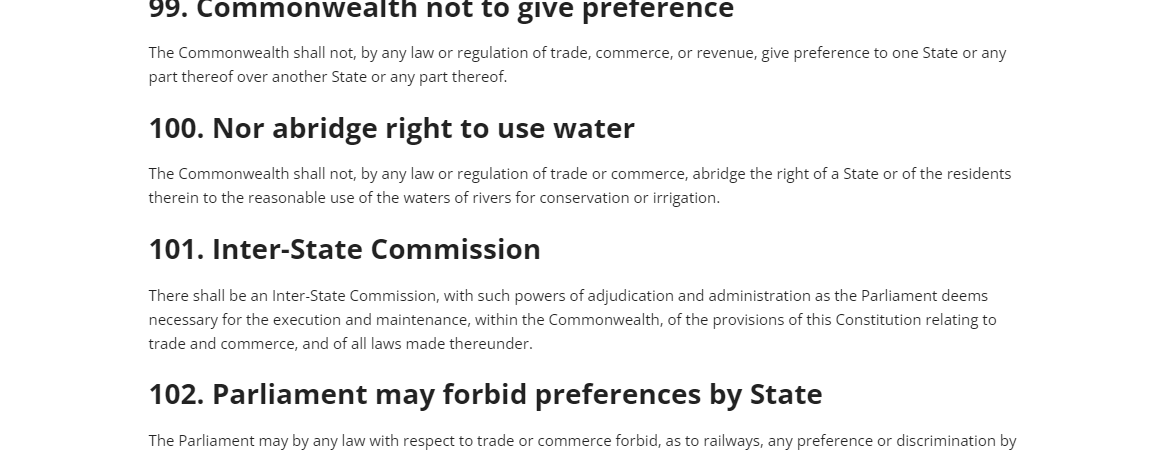
The Australian Constitution outlines that Australia's waters are the responsibility of State and Territory jurisdictions (Section 100).
Overtime Federal Government intervention and direction in water policy has increased. Particularly due to coordination across state boundaries and the desire for national consistency through Federal oversight has been enabled. This has progressively occurred as water resources were developed.
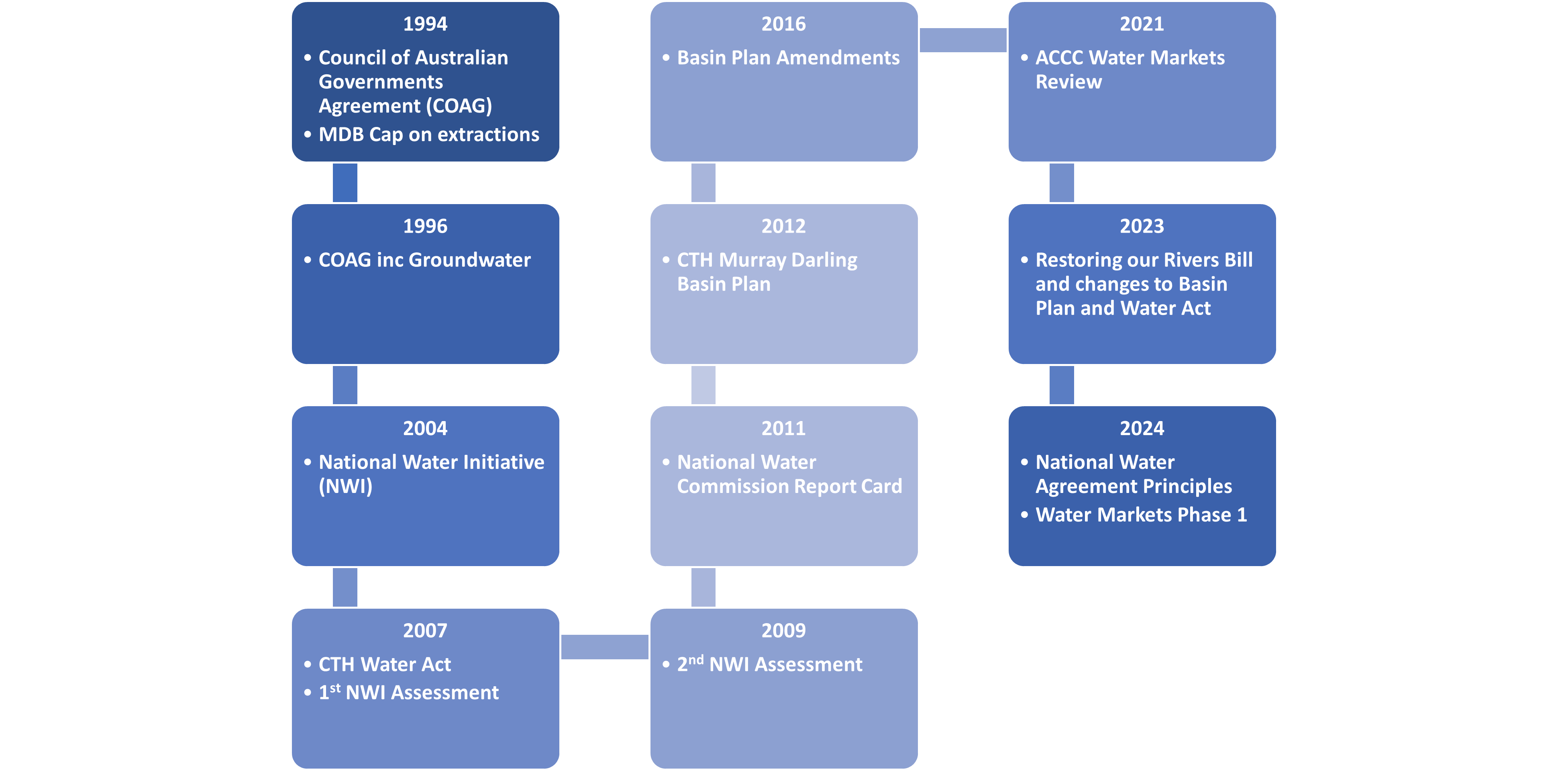
Australia's foundational document for water law and planning is arguably the National Water Initiative which was agreed in 2004 as an intergovernmental agreement after more than a decade of discussions from the first Council of Australian Governments meeting in 1994. States and Territories agreed in 2004 to implement 10 objectives and complete more than 110 actions to implement the agreement, including the creation of state water management law, which is how the NWI become the blueprint for Australian water management.
"23 Objectives:
Full implementation of this Agreement will result in a nationally-compatible, market, regulatory and planning based system of managing surface and groundwater resources for rural and urban use that optimises economic, social and environmental outcomes by achieving the following:
i. clear and nationally-compatible characteristics for secure water access entitlements;
ii. transparent, statutory-based water planning;
iii. statutory provision for environmental and other public benefit outcomes, and improved environmental management practices;
iv. complete the return of all currently overallocated or overused systems to environmentally-sustainable levels of extraction;
v. progressive removal of barriers to trade in water and meeting other requirements to facilitate the broadening and deepening of the water market, with an open trading market to be in place;
vi. clarity around the assignment of risk arising from future changes in the availability of water for the consumptive pool;
vii. water accounting which is able to meet the information needs of different water systems in respect to planning, monitoring, trading, environmental management and on-farm management;
viii. policy settings which facilitate water use efficiency and innovation in urban and rural areas;
ix. addressing future adjustment issues that may impact on water users and communities; and
x. recognition of the connectivity between surface and groundwater resources and connected systems managed as a single resource."
Furthermore, the NWI called for the unbundling of land and water, creating a separate property right - water access entitlement, to land rights.
"28 Water Access Entitlements:
The consumptive use of water will require a water access entitlement, separate from land, to be described as a perpetual or open-ended share of the consumptive pool of a specified water resource, as determined by the relevant water plan (paragraphs 36 to 40 refer), subject to the provisions at paragraph 33.
31. Water access entitlements will:
i) specify the essential characteristics of the water product;
ii) be exclusive;
iii) be able to be traded, given, bequeathed or leased;
iv) be able to be subdivided or amalgamated;
v) be mortgageable (and in this respect have similar status as freehold land when
used as collateral for accessing finance);
vi) be enforceable and enforced; and
vii) be recorded in publicly-accessible reliable water registers that foster public
confidence and state unambiguously who owns the entitlement, and the nature of
any encumbrances on it (paragraph 59 refers).
32. Water access entitlements will also:
i) clearly indicate the responsibilities and obligations of the entitlement holder
consistent with the water plan relevant to the source of the water;
ii) only be able to be cancelled at Ministerial and agency discretion where the
responsibilities and obligations of the entitlement holder have clearly been
breached;
iii) be able to be varied, for example to change extraction conditions, where mutually
agreed between the government and the entitlement holder; and
iv) be subject to any provisions relating to access of water during emergencies, as
specified by legislation in each jurisdiction."
In 2007, a Commonwealth Water Act to address environmental concerns and further support consistency of management in the Murray Darling Basin was forged. It is Australia's primary legislation that concerns the Commonwealth Government's powers over the Murray–Darling Basin and enables the establishment of the Murray Darling Basin Plan, and assciated beauracraces of the Murray Darling Basin Authority, the Commonwealth Environmental Water Holder and the Inspector General Water Compliance to implement and enforce the plan.
The Act's objectives include the management
of the Basin's water resources,
addressing threats
to the Basin,
promoting the environmentally,
economically and socially sustainable use
of the Basin's resources, conservation of
the Basin ecosystem,
maximising the economic benefit to the Basin communities, and improving water
security.

NIC provided their final submission into the Indepedant Reviewer for the Statutory Review of the Water Act.
Key points included ensuring the Water Act reflects the constitutional arrangements for water, reshaping the Act to reflect the changed roles of the Murray Darling Basin Plan from a plan of recovery to management and ensuring the froundations of water management framework, agreed in 2004 are reflected in legislation.
The National Irrigators’ Council (NIC) sent a clear message at the National Bush Summit: ‘enough is enough’ of taking water away
from farmers.
“Communities are at tipping point right around the Basin,” said Zara Lowien, CEO of NIC, after 1 in 3 litres of water has been removed from
farming over more than 30 years of reform. [...]
The Australia Government together with State and Territories have agreed to released the proposed new National Water Agreement following the recent National Cabinet Meeting.
Find out more about our community, and join our mission advocating for the Australian irrigated
agriculture industry.