
NATIONAL IRRIGATORS’ COUNCIL

POLICY PORTFOLIO - MURRAY DARLING BASIN PLAN

Advocating for the Australian irrigated agriculture industry

The Murray Darling Basin Plan

The Murray Darling Basin Plan "the Plan") became Commonwealth legislation in 2012.  It was enabled under the Water Act 2007.  The plan outlines the management of water resources in the Murray-Darling Basin, including water allocation, environmental water management, and water quality standards.

The Plan has been amended twice since becoming law:

  • 2017/18: Amendments to reduce the Water Recovery targets for the Northern Basin, enable Sustainable Diversion Limit Adjustment Mechanism and the additional 450GL of environmental water to be achieved with neutral socio-economic outcomes. 
  • 2023: Restoring Our Rivers Bill amended key timelines for implementation, broadened the environmental objectives for the additional 450GL environmental water and enables other mechanisms of recovery without the need for neutral socio-economic outcomes, and removed limits on water purchases.

The Plan is scheduled for review by the Murray Darling Basin Authority in 2026.

Find Out More Find Out More


'Moving Forwards: Our Review into the Murray Darling Basin Plan' is a series of comprehensive papers by National Irrigators' Council based on the key themes identified by the MDBA in their Early Insights Paper and aims to start a conversation on how to enable improvements in the Basin Plan and enhance environmental outcomes with the water already held for environmental purposes. 


See Report
See Report

Snapshot of environmental outcomes

  • Over the 9-year period, 15,443 GL of Commonwealth environmental water was delivered to 56 ecosystem types representing 249,079 ha of lakes and wetlands, 187,486 ha of floodplain, 27,715 km of waterways and 23,768 ha of estuarine ecosystems - Flow-MER_22-23 Synthesis Report (CEWH).
  • The largest bird-breeding events in the decades in 2022-2023 were supported by natural flows and various forms of environmental water- DCCEEW.
  • Increased abundance in native fish and improved resilience of native fish - CEWH
  • Improved connectivity between the Lakes, Coorong and Murray Mouth with 10 years of continuous flow and increased barrage flows, the maintenance of lake levels and salinities within optimal ranges in SA Lower Lakes - Monitoring Report -CLLMM.
  • The export of at least 4.2 million tonnes of salt through the barrages at South Australia - Benefits of water for the environment (DCCEEW).


Water Recovery Progress

Water recovery towards the Murray Darling Basin Plan Sustainable Diversion Limits and compliance with those limits, is monitored by the Murray Darling Basin Authority.


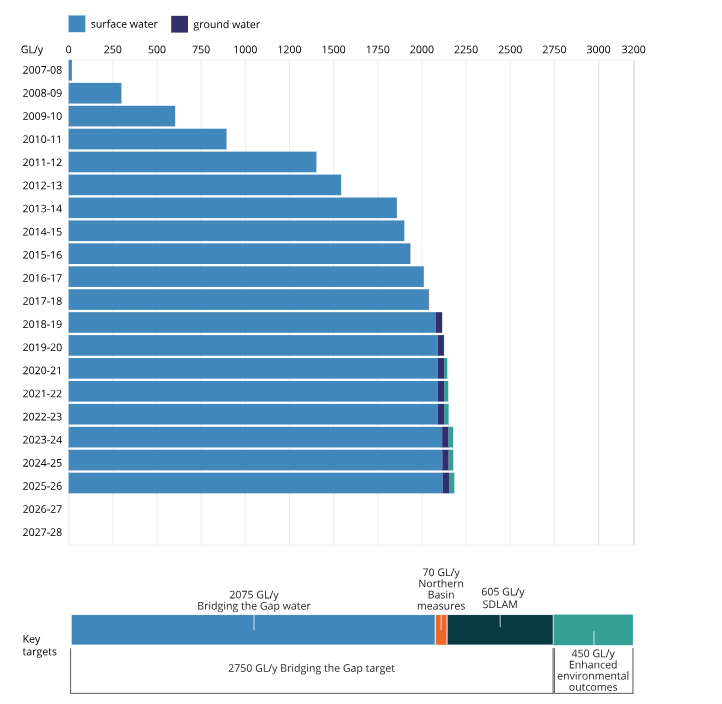
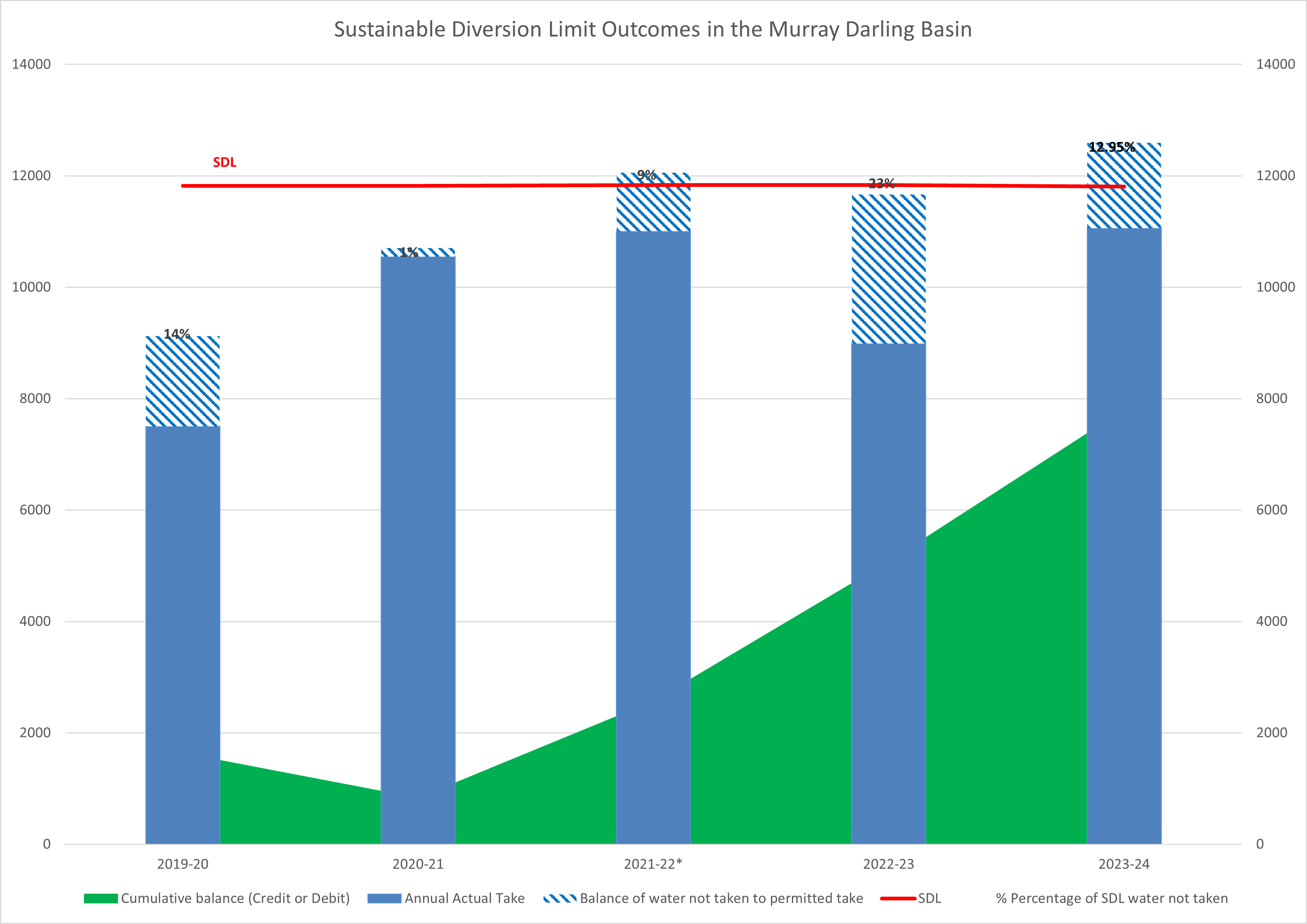
As reported in the August Sustainable Diversion Limit Water Take Report the Basin Plan Sustainable Diversion Limits are being achieved with all water resource plan units compliant. 


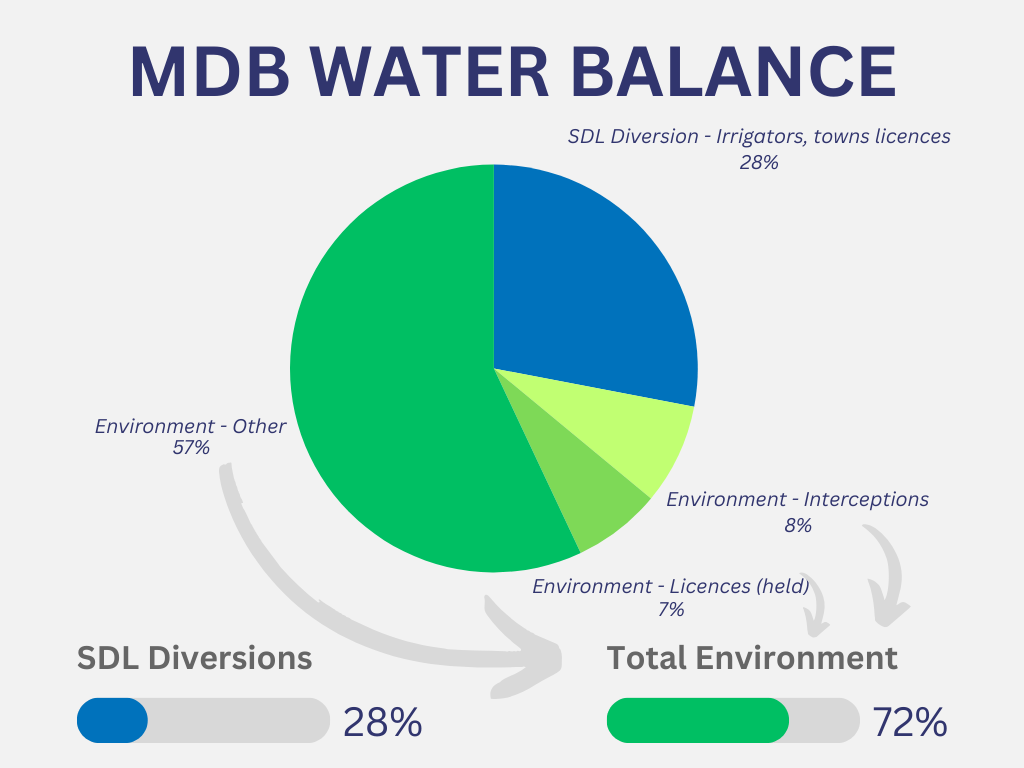
The progress to-date means  that 1 in 3 litres of water for agriculture is now held by environmental water holders.  This is a total reduction in water availability meaning 72% of average river flows are for the environment and 28% to water users.


KEY MESSAGES

The National Irrigators' Council wants to see healthy rivers and wetlands because we are locals too and that is why we are committed to enforcing compliance with current Sustainable Diversion Limits  - as the core component of the Murray Darling Basin Plan.

Future Basin Plan implementation must focus on moving beyond ’just add water’. Governments must optimise outcomes through being smarter and more strategic with environmental water; investing in complementary measures (such as invasive species control, fish passageways, habitat restoration, fish screening, riparian land management); and a paradigm shift of working together.


Policy Position Statements relating to the Murray Darling Basin Plan

Finalising the Murray Darling Basin Plan

Position Statement

SDLAM Reconciliation

Position Statement

Constraints Management

Position Statement

Reliability of Water Access Entitlements

Position Statement Agreed July 2025


Key Related NIC Resources on the Murray Darling Basin Plan

 NIC report reviewed the Federal Government’s purchases and found most have low environmental utility and cannot directly contribute to today’s environmental priorities in the Basin – despite costing taxpayers billions.“These additional water buybacks go beyond what was required to ‘bridge the gap’ to get Sustainable Diversion Limits in place for the Basin Plan,” said NIC CEO Zara Lowien “most of this additional water will not be able to be used as intended and unlikely to contribute to desired environmental outcomes”. [...]

There have been several concerns raised regarding the Federal Government’s decision to purchase additional water from farmers that go beyond the water recovery required to ‘bridge the gap’ to reduce water usage to Sustainable Diversion Limits (SDLs), in the Murray-Darling Basin Plan. The concerns relate to the effectiveness or need for additional water acquisition, with questions on how the Government’s actions are contributing to policy outcomes, meeting value for taxpayers’ money, and consider the growing evidence that signals alternatives approach to ‘just adding water’ are needed to enhance environmental outcomes around the Basin.

This Report by NIC, provides a preliminary assessment of the Federal Government purchases of additional water under “the 450 GL” program of the Plan. [...]

This update relates to persons or classes of people required to report water market information under the Australian Government water market regulation - this can be IIOs and water intermediaries.

DCCEEW are seeking feedback on the Exposure Drafts for the proposed Water Amendment (Water Markets Information) Regulations 2026 (Regulations) and the Water Market Data Standards.  These form the final pieces of the water market reform roadmap and are due for implementation in 2026.

Exposure drafts and a survey for feedback are provided on the webpage.

Join Our Community

Find out more about our community, and join our mission advocating for the Australian irrigated agriculture industry.

Our Community
Our Community


Website Disclaimer |  Privacy Policy |  Terms & Conditions