
Second Review of additional Held Environmental Water
The NIC continues to monitor the Federal Government’s implementation of the additional Held Environmental Water (HEW) program under the
Murray-Darling Basin Plan, commonly referred to as the “450 GL program” against the Commonwealth Procurement Rules, the DCCEEW Framework for
Delivering the 450 GL and the policy objectives of the Basin Plan. We completed our first review in December 2025, and the
second in June 2026.
The 450GL program is designed to recover additional water from farmers that go beyond the water recovery required to ‘bridge the gap’ to
reduce water usage to Sustainable Diversion Limits (SDLs).
The 450 GL program has fundamentally changed since it was first conceived. The original budget has been exhausted, expected costs have escalated significantly, the scope of the program has expanded, and new environmental evidence has emerged. Despite these material changes, there has been no transparent reassessment of whether continued expenditure represents the most effective, efficient and economical investment to achieve environmental outcomes and deliver benefits to the Australian economy.
The first question was whether the Federal Government could acquire additional water from willing sellers.
The question now is whether continuing to do so represents the best investment for Australia’s environment, economy and communities.
Concerns relate to:
- whether scope and budge changes should have triggered a broader review of the likley benefits from the increased costs of the revised program;
- the effectiveness or need for additional water acquisition;
- questions on how the Government’s actions are contributing to policy outcomes;
- value for taxpayers’ money;
- the growing evidence that signals alternatives approach to ‘just adding water’ are needed to enhance environmental outcomes around the Basin;
- socio-economic and market impacts of ongoing purchases.
The water purchased under “the 450 GL” program is additional to what is required to achieve the Basin
Plan SDLs.
Most of the water cannot be physically delivered through rivers to intended effect, has low
environmental utility, is not aligned with the MDBA’s current science on environmental priorities and does not represent value for money.
The 450 GL program has fundamentally changed since it was first conceived. The original budget has
been exhausted, expected costs have escalated significantly, the scope of the program has expanded, and new environmental evidence has
emerged. Despite these material changes, there has been no transparent reassessment of whether continued expenditure represents the most
effective, efficient and economical investment to achieve environmental outcomes and deliver benefits to the Australian economy.
An Independent Review of program outcomes is needed to inform current and future investment decisions
to enhance environmental outcomes.
Greater environmental outcomes could be achieved if the program focus and funding was redirected to community-supported constraints management, and complementary measures.
Not needed
1 in 3 litres of water from irrigation has already been recovered for the environment.
Total diversions for all users combined is now just 28% of inflows, well within global standards.
Not effective
It is also not cost-effective, with future implementation already $1 billion over budget.
Not the priority
Why these reports?
There have been several reports on the implementation of the Basin Plan, and particularly on key programs. However, to date, the 450 GL purchasing program has not received this same scrutiny, despite being highly contested.
The reviews which have occurred have focused on outputs (i.e. the acquisition of water), rather than the actual outcomes that is intended to achieve, and the effectiveness of those purchases towards those outcomes.
What did we do?
These Reports provides a preliminary assessment of the Federal Government purchases of additional water under “the 450 GL” program of the Plan.
Specifically, it looks at its alignment with:
- the Department of Climate Change, Energy, Environment and Water’s (DCCEEW) Framework to Deliver enhanced environmental outcomes in the Murray Darling Basin[1];
- the Commonwealth Procurement Rules[2];
- intended policy objectives as outlined within the Plan.
Key findings from December 2025 Report
This Report exposes flaws in not only the Government’s logic to prioritise more water purchases whilst SDLs are already in-force, without any long-term commitment to ensuring its utility, but also a failure to link outputs (volumes) with outcomes (environmental needs and benefits), even when considering value for money criteria. In addition, this report highlights ineffective measures to consider and minimise socio-economic impacts on communities from additional water purchases.
- The continued recovery of water beyond what is required for SDL compliance (i.e. additional HEW beyond 62 GL) is not commensurate with the scale and scope of Basin Plan implementation. The Federal Government has recovered more than double the minimum target and is now going beyond reasonable steps.
- 65% of entitlements purchased under the 450 GL program in the Southern Basin are subject to major delivery restrictions of some form, meaning they cannot be delivered through the river system as intended. For future purchases in EOI 1, 75% of what is on offer (and within market prices) is subject to delivery restrictions. This significantly reduces environmental effectiveness.
- Continuing to recover additional HEW, without constraints relaxed, is acquiring a public asset with no certain pathway to it being utilised to intended effect, anytime soon. Prioritisation must be for community-supported constraints measures, prior to additional water recovery.
- Spending under the 450 GL program does not reflect the Government’s own science on priorities for environmental investment in the Basin. The Government’s own environmental science finds flow-based indicators performing well but non-flow-based indicators scoring more poorly. This supports focus on complementary measures, as a higher priority than additional HEW.
- The Government will have to purchase the equivalent of more than 100% natural market annual turnover to achieve the 450 GL target.
- 100% of the 450 GL to date has been from water purchases in some form. There are no non-purchases options, all options by legislation must reduce the productive pool.
- Water recovery has not been steady nor staged, contrary to the Government’s purchasing framework.
- Poor socio-economic assessment, including data limitations and poor program implementation, means the Minister cannot meet legislative obligations to robustly consider socio-economic impacts.
- Almost all Framework principles and key measures to minimise the adverse socioeconomic impacts have not been implemented.
- The use of rules-changes that have reliability impacts as a water recovery tool risks substantial financial liability on Basin States, and major governance challenges, rendering the approach non-feasible.
- The continued recovery of additional HEW cannot be considered value for money, as per the Commonwealth Procurement Rules.
Key Findings from June 2026 Report
- 73% of entitlements purchased under the 450 GL program in the Southern Basin alone are subject to major delivery restrictions of some form, meaning they may not be delivered through the river system as intended. This significantly reduces environmental effectiveness. This is an increase from 65% in the original report, showing an increasing trend.
- 100% of the entitlements purchased (or otherwise accounted for) under the 450 GL program in the Northern Basin are subject to major delivery restrictions of some form.
- When including both the Southern and Northern Basin, the total percentage of water entitlements recovered under the program subject to major delivery restrictions grows to 77%.
- Spending under the 450 GL program does not reflect the Government’s own science on priorities for environmental investment in the Basin with 92 % of environmental indicators did not change between water increasing recovery scenarios part of work to inform the MDBA’s initial SDL assessments. The Government’s own environmental science finds flow-based indicators performing well but non-flow-based indicators scoring more poorly. This supports focus on complementary measures and community supported constraints management, as a higher priority than additional held environmental water.
- Any new purchases towards the 450 GL after May 2026 are beyond the original budget of $1.575B for the Water for Environment Special Account and must now be funded from the budget items not for publication, significantly reducing transparency of total expenditure. This is a material change to the program budget, that should require an updated assessment of whether this increasing investment remains justified, what environmental benefits are expected under the revised program, or whether those benefits outweigh the costs to the Australian economy.
- Estimates of an additional funding of $1.3 billion to complete the 450 GL target are now conservative.
- The Federal Government designed the 450GL purchase framework with the intent to mitigate some of the known social and economic impacts from the additional water purchases but evidence since suggests these elements of the framework were ignored, diminishing the likely effectiveness of key social and economic impact mitigation measures.
-
The budget, scope and purpose of the 450GL program has materially changed but the Federal Government has not reassessed the broader
benefits to the Australian economy, raising these questions:
- Is the additional expenditure for the program that is currently not for publication to the Australian public in the economies interest and benefit?
- What are the modified environmental benefits since the RoR Bill?
- Are the total costs for the modified environmental outcomes, still in the interests and benefit for the economy?
- Do the purchases represent value for money?
- The s86ADB statutory assessments to consider the socio-economic impact of tenders to purchase additional environmental water do not include direct consideration of the broader benefits to the Australian economy.
- Up to May 2026, 25% of water purchase contracts reported were greater than $1 million and there was no evidence of an assessment or consideration of how these contracts would benefit the Australian economy.
Recommendations
These Reports highlights the need for independent review of the program outcomes, against the broader question of value, effectiveness and efficiency to contribute to the intended policy objectives in the Murray Darling Basin – an outcome review, rather than the current output focused reviews to-date.
An Independent Review should help add vital information to the Review of the Murray Darling Basin Plan and any Government response to
reconciled shortfalls in Basin Plan recovery targets, as it should aim to ensure the current and future investment delivers the greatest
environmental outcomes for the dollars spent, against current priorities
With the Murray Darling Basin Plan Review underway and the current fiscal environment, the Federal Government should halt any further water
recovery until the completion of an Independent Outcome Review, as proposed by this report.
Resources
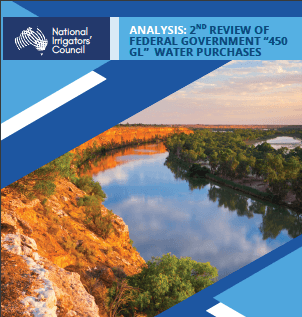
NEW REPORT June 2026 Review of HEW Report
NIC 2nd Review of Federal Government purchases of additional Held Environmental Water (the “450 GL”) under the Murray-Darling Basin Plan
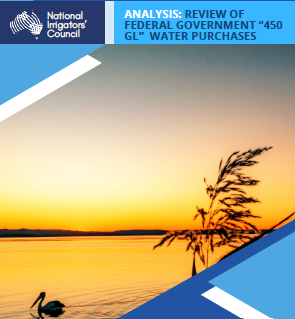
December 2025 Review of HEW Report
NIC Review of Federal Government purchases of additional Held Environmental Water (the “450 GL”) under the Murray-Darling Basin Plan

Basin Plan
NIC webpage on the Murray Darling Basin Plan

Moving Forwards
NIC Basin Plan Review
[1] DCCEEW Framework for delivering the 450GL
[2] Commonwealth Procurement Rules 2025