National Water Agreement released
The Australia Government together with State and Territories have agreed to released the proposed new National Water Agreement following the recent National Cabinet Meeting.

NATIONAL IRRIGATORS’ COUNCIL
Advocating for the Australian irrigated agriculture industry

The Murray Darling Basin Plan "the Plan") became Commonwealth legislation in 2012. It was enabled under the Water Act 2007. The plan outlines the management of water resources in the Murray-Darling Basin, including water allocation, environmental water management, and water quality standards.
The Plan has been amended twice since becoming law:
Water recovery towards the Murray Darling Basin Plan Sustainable Diversion Limits and compliance with those limits, is monitored by the Murray Darling Basin Authority.
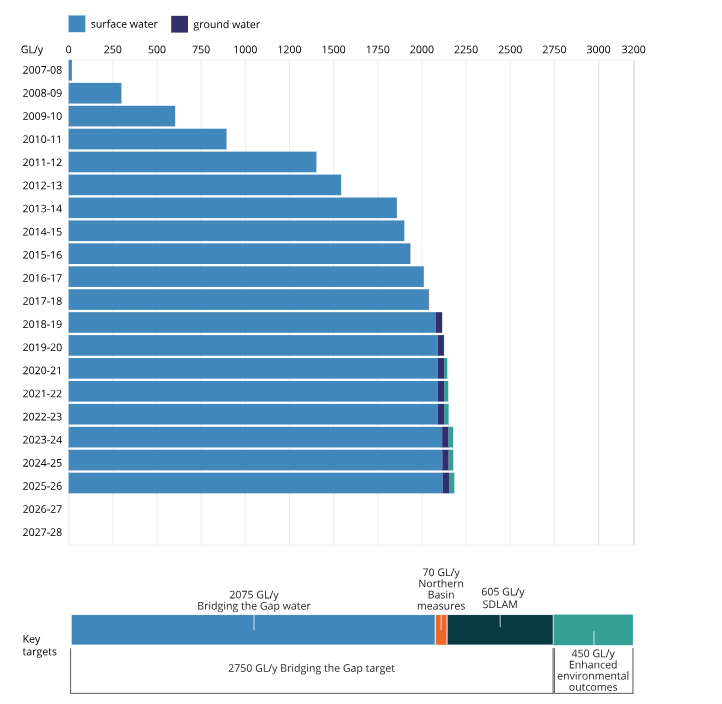
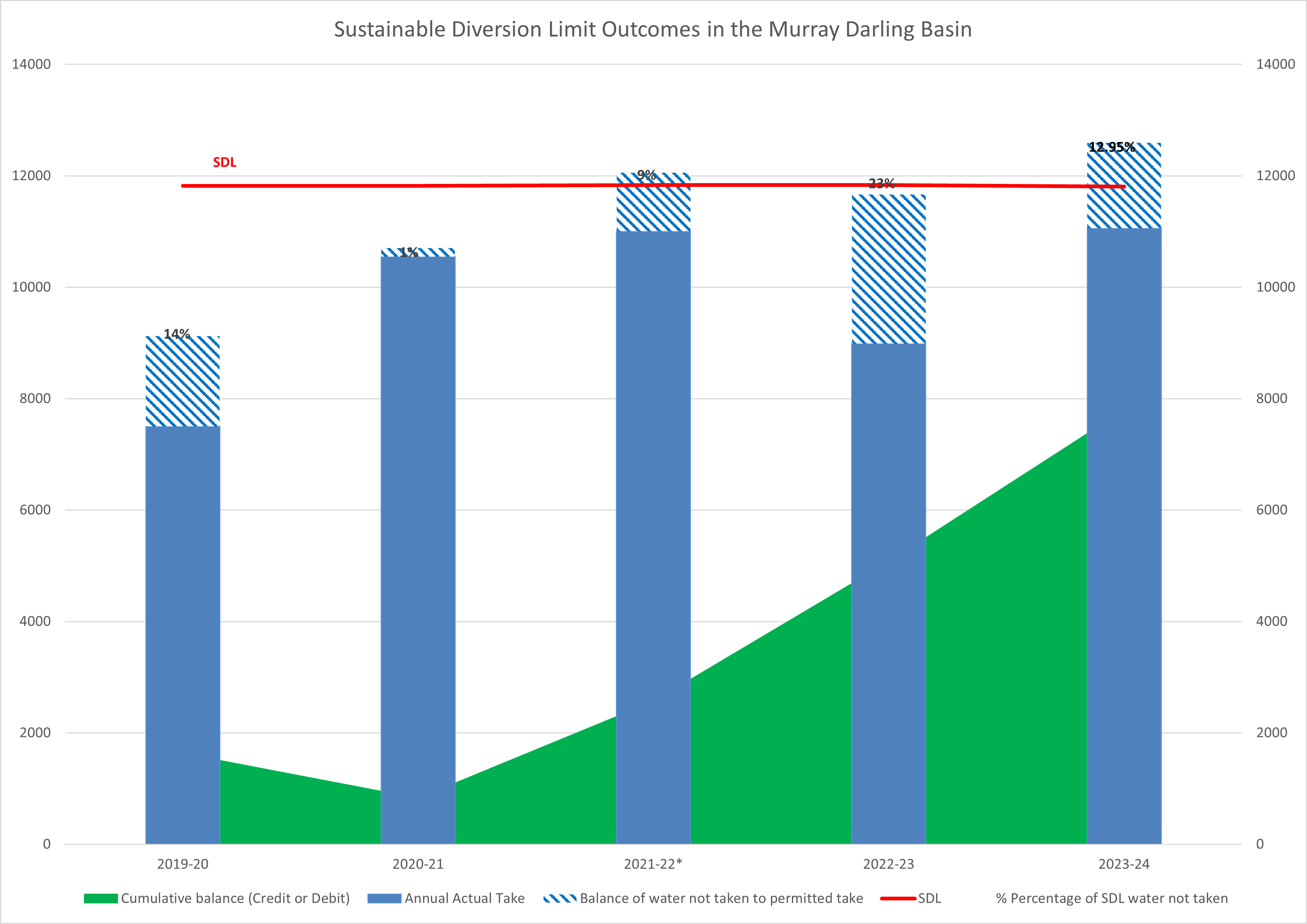
As reported in the August Sustainable Diversion Limit Water Take Report the Basin Plan Sustainable Diversion Limits are being achieved
with all water resource plan units compliant.
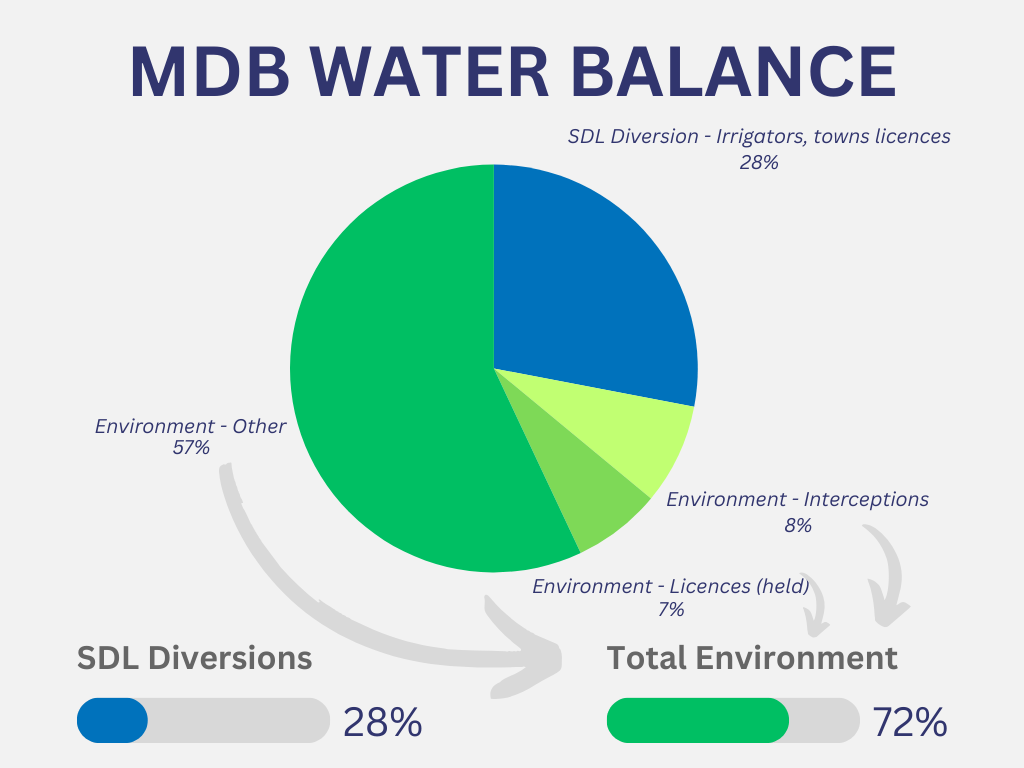
The progress to-date means that 1 in 3 litres of water for agriculture is now held by environmental water holders. This is a total reduction in water availability meaning 72% of average river flows are for the environment and 28% to water users.

KEY MESSAGES
The Australia Government together with State and Territories have agreed to released the proposed new National Water Agreement following the recent National Cabinet Meeting.
Australia's food security strategy cannot ignore water as a critical input, according to irrigation industry leaders in Canberra attending the National Farmers Federation Summit today.
National Irrigators' Council, NSW Irrigators' Council, Ricegrowers' Association, Citrus Australia and Cotton Australia were united in their call that water policy belongs in Australia's food security conversation. [...]
A new report has found levels of water use across the Murray-Darling Basin are fully compliant with the Basin Plan’s Sustainable Diversion
Limits (SDLs), which irrigators say shows ‘the job is done’.
“Water use across the Basin is fully compliant with the Sustainable Diversion Limits set by the Basin Plan,” said Zara Lowien, CEO of the
National Irrigators’ Council (NIC).
“It’s very clear that over-extraction is no longer the issue for the Murray-Darling Basin.”
Basin officials have confirmed 14 environmental projects will be withdrawn from formal recognition under the Murray-Darling Basin Plan placing Southern Basin communities at risk of losing up to a further 355 GL of water through no fault of their own.
“The environmental outcomes from these projects cannot be achieved by ‘just adding more water’,” said CEO of the National Irrigators’
Council (NIC), Zara Lowien, “in fact, these projects are essential to actually use all the water the Government has already recovered from
farmers.Withdrawing these projects is a lose-lose situation for communities and the environment." [...]
The NIC continues to monitor the Federal Government’s implementation of the additional Held Environmental Water (HEW) program under the Murray-Darling Basin Plan and has released a second report, following our December 2025 analysis.
The 450 GL program has fundamentally changed since it was first conceived. The original budget has been exhausted, expected costs have
escalated significantly, the scope of the program has expanded, and new environmental evidence has emerged. Despite these material changes,
there has been no transparent reassessment of whether continued expenditure represents the most effective, efficient and economical
investment to achieve environmental outcomes and deliver benefits to the Australian economy [...]
The MDBA together with the Australian Rural Leadership Foundation are hosting a free webinar to hear more about their new leadership initiative - A leadership program for people ready to work across sectors, communities and perspectives to support the long term health of the Basin and the communities it sustains. For anyone interested in learning more about this opportunity, a webinar is being held on Wednesday 20th May 2026 | 4pm - 5pm.
This submission is provided to the Productivity Commission’s (PC) fourth inquiry on governments’ progress under the National Water Initiative (NWI), as required by the Water Act 2007 (Cth). NIC notes that this inquiry comes at a time of significant review, and potential change, of water policy settings across Australia, particularly in the Murray-Darling Basin (MDB). The consultation burden affects stakeholders and Government.
This submission is provided to the review of the operation and management of the Menindee Lakes system. Many of our Members are critically linked into the frameworks and operations of Menindee Lakes via existing sharing arrangements through the Murray Darling Agreement or local sharing plans - above and below the Lakes. This submission therefore represents the views of irrigation entitlement holders and water users, and non-government water delivery networks, up and downstream of the Lakes.
Legalwise is again holding their annual Water Law Symposium in Sydney.
As water law continues to evolve in response to environmental challenges, policy reform and heightened regulatory scrutiny, secure expert
guidance on key legal and strategic issues shaping Australia’s water governance framework. You will gain insights into the lessons of
the past decade in water reform, the intersection of Indigenous rights and governance, and the design of the Basin Plan Review.
A first look at the Murray Darling Basin Authority’s Basin Plan Review discussion paper, reveals again that more is needed than “just adding water” to improve the environments of the Basin. “The discussion paper should serve as an important wake up call to the Federal Government who continue to use old tools, for today’s challenges”, said NIC CEO, Zara Lowien.[...]
The MDBA have opened registrations for a series of webinars to support their consultation approach on the Basin Plan Review. The initial topics being how to make a submission, Menindee and SDL assessments. The webinars will be recorded and start from Monday next
week.
A link on these webinars is not yet available on their website but is available by clicking here.
NIC report reviewed the Federal Government’s purchases and found most have low environmental utility and cannot directly contribute to today’s environmental priorities in the Basin – despite costing taxpayers billions.“These additional water buybacks go beyond what was required to ‘bridge the gap’ to get Sustainable Diversion Limits in place for the Basin Plan,” said NIC CEO Zara Lowien “most of this additional water will not be able to be used as intended and unlikely to contribute to desired environmental outcomes”. [...]
There have been several concerns raised regarding the Federal Government’s decision to purchase additional water from farmers that go beyond
the water recovery required to ‘bridge the gap’ to reduce water usage to Sustainable Diversion Limits (SDLs), in the Murray-Darling Basin
Plan. The concerns relate to the effectiveness or need for additional water acquisition, with questions on how the Government’s actions are
contributing to policy outcomes, meeting value for taxpayers’ money, and consider the growing evidence that signals alternatives approach to
‘just adding water’ are needed to enhance environmental outcomes around the Basin.
This Report by NIC, provides a preliminary assessment of the Federal Government purchases of additional water under “the 450 GL” program of
the Plan. [...]
This update relates to persons or classes of people required to report water market information under the Australian Government water market
regulation - this can be IIOs and water intermediaries.
DCCEEW are seeking feedback on the Exposure Drafts for the proposed Water Amendment (Water Markets Information) Regulations 2026
(Regulations) and the Water Market Data Standards. These form the final pieces of the water market reform roadmap and are due for
implementation in 2026.
Exposure drafts and a survey for feedback are provided on the webpage.
NIC has completed our own internal review into the Murray Darling Basin Plan, which is a series of papers addressing the key themes of
the 2024 Early Insights paper using the recently published “Triple Crown of Water Reform Framework” to highlight possible next
steps for the Basin Plan. We hope to help forge a future pathway that embraces the paradigm shift needed for the Basin that is more
about a 'plan of management' than the current ‘water recovery plan’ focus. The review addresses; regulatory design, sustainable water limits, climate change, environment, agriculture and community and contemporary issues.
We encourage stakeholders to reach out to discuss these papers, the evidence, our findings and recommendations.
Irrigation Australia Limited's Spring Journal features our CEO, Zara Lowien's comments on the 2025 Basin Plan Evaluation (on page 32-35) indicating there were plenty of first the MDBA's 'game changing' 2025 evaluation but what does it mean for the irrigation industry. Zara highlighted the opportunity before Minister Watt has to work collaboratively with communities and industry on a much-needed reset, that looks to refocus the Basin Plan on outcomes rather than numbers.
Australian Farm Institute, Executive Director Katie McRobert says "Much of Australia’s agricultural policy is caught in a loop. When a crisis erupts – be it drought, market disruption, or community outrage – political and media attention surges. Decisions are demanded, headlines written, levers pulled. But as the immediate threat subsides, so too does the will to implement lasting solutions...This edition of the Farm Policy Journal explores that cycle – and asks what we can do to break it. ....The opening article by Christine Freak and Zara Lowien examines the long and often reactive trajectory of water policy reform in the Murray–Darling Basin (MDB)...[They] offer offer an original contribution to this challenge in the form of the Triple Crown of Water Reform Framework, which conceptualises reform as a three-pronged effort: water-sharing (Flows), watermanagement (Functions), and integrated resource initiatives (Further)."
We have just put in our submission for the third Water for Environment Special Account (WESA) review - take a look.
Our key recommendation: "The Independent Panel take a broad view to examine the policy settings and decision-making on the use of
WESA funds to achieve enhanced environmental outcomes with consideration of socio-economic impact - to ensure WESA can be used
transparently to target priority environmental investments. We encourage you to explore the option to amend the WESA to ensure it can be
used transparently to target priority environmental investments such as community-supported constraints measures and investment in non-flow
complementary measures as evidence within the 2025 Basin Plan Evaluation and Sustainable Rivers Audit."
Thank you to our members who have contributed to this piece of work, and taking the time to provide feedback.
If there's one video those working in water must watch this year, it's this - Professor Forest Reinhardt from Harvard Business School talking to Andrew McConville at this years River Reflections Conference on water property rights (watch from 45 minutes
into Day 1).
Let us know your favourite quotes!
One of our favourites (1hr 18mins in) - in response to a question on what a future Basin Plan should look like: "If the subsequent
versions of the Basin Plan, can make water more and more like a normal commodity... just as if you own a piece of land... I think
that the more you can make water rights look like normal property rights, the more effective the system will be. I come from a country
where we can't even get to the starting line of that kind of thing."
Today’s publication of the Murray Darling Basin Authority’s (MDBA) 2025 Basin Plan Evaluation and Sustainable Rivers Audit has found the health of the Basin has improved, advising that “water for the environment is essential, but on its own is likely not sufficient” [MDBA Overview]... The National Irrigators’ Council has described many parts of the Evaluation as refreshing and a wakeup call needed to shape thinking in the Basin going forward and is calling for more quick thinking on how to determine and prioritise a package of strategic environmental investments in these complementary (non-flow) measures to inform next steps on the Basin Plan, given the Evaluation found this as a missing piece of the current Plan puzzle. [...]
Basin communities fear socio-economic impact assessments soon to be released by the Murray-Darling Basin Authority (MDBA) will water down the true impact, overlooking community and industry-level data, in their Basin-scale assessment. “Basin Plan legislation requires 5-yeraly Evaluations, but at a Basin-scale”, said Zara Lowien, National Irrigators’ Council (NIC) CEO, “we know the most severe impacts are felt at a local community level, and within specific industries, but these impacts get smoothed out when the assessment zooms to the Basin-scale.” [...]
|
NIC Members agreed to a specific Position Statement on the reliability of water access entitlements to provide a clear message to Governments on how decisions impact water property rights, as represented and agreed in the National Water Initiative. This position statement was prepared in conjunction with our guiding principles. Approved 17 July 2025. |
14th May 2025, Canberra, ACT: The National Irrigators’ Council (NIC) congratulates Murray Watt on his appointment as the Minister for the Environment and Water, saying this is an opportunity for new leadership to put policy above politics and partnerships over partisanship. “Until recently, water management in Australia has had a long history of bipartisanship across politics. We hope under new leadership... we can see a return to respectful and constructive water policy solutions, that can once again rise above politics,” said NIC CEO, Zara Lowien. [...]
DCCEEW today released the Exposure Draft of the Water Markets Intermediaries Code (the Code) and an Overview of the draft are now available for consultation. On this page you will be able to submit your feedback on the Exposure Draft. The consultation will be open until 11.59pm on Sunday 6 April 2025. The Exposure Draft incorporates feedback from the Policy Position Paper consultation in November-December 2024.
DCCEEW today released their Final policy position paper on the water market intermediaries trust accounting and code exemptions, the final
position to inform the future exposure regulations.
We will review this with interest given the concerns raised regarding the likely impacts and expectations on some intermediaries.
Irrigators call out Minister Plibersek’s decision to sign off on purchasing another 100 GL of water in the southern Basin with questionable
procurement processes and deliberately narrow evidence to support the decision.
“The advice before the Minister to inform the decision is flawed,” said Zara Lowien, CEO of National Irrigators’ Council. [...]
The release of the Auditor General’s report of the Federal Government’s water buybacks finds the Government implemented a well-paved road
of effective process but struggled to find the link between the buyback program and the intended policy objectives for the Murray Darling
Basin Plan.
“Many will glance at the key findings of effective process and give the Government a pat on the back, but the devil is in the detail when
the report goes on to question the link between the buyback program and the intended policy objectives for the environment” said National
Irrigators’ Council CEO, Ms Lowien [...]
Minister Plibersek tabled the Australia Audit Office's review of the 2023 Strategic Purchases for Bridging the Gap, which you may recall the Inspector General recently found flaws in governance and managing conflicts.
The report identified steps were taken to address earlier deficiencies and that processes stacked up. What was interesting to read in
the detail were questions and recommendations about the purpose of these purchases towards the overall policy outcomes, which you will hear
more from NIC about this area
NIC today lodged their submission to DCCEEW on the Water Market reform - Intermediaries Code and Statutory Trust Account Policy Position paper with an overarching concern that the regulatory burden of this reform, particularly given its scale and pace. We are also concerned that the reform is going too far, and is becoming disproportionate to the problem at hand, and the size and extent of water markets. While market integrity, transparency and good governance are important – there is enormous risk of not striking the right balance for a proportionate policy response […]
National Irrigators’ Council (NIC) expressed its sincere gratitude to Sir Angus Houston, who has led the MDBA since 2020. Under Sir Angus'
leadership, significant progress has been made in fostering better relationships with communities across the Basin, prioritising
transparency, and restoring trust in the management of the Murray-Darling Basin Plan.
"Sir Angus Houston's dedication to listening to Basin communities and his focus on repairing relationships and trust have been crucial
during a period of significant uncertainty and challenge," said Zara Lowien, CEO of NIC.[...]
The Inspector General this week released their 2022-2023 Murray Darling Basin
Compliance Report. The
report states that "this compliance performance report provides a sample of common compliance activities metrics for each Basin State
which will be incorporated into progressively broader reporting under a Basin-wide compliance performance reporting scheme. It is also
anticipated that future reporting on compliance activities will be at the water resource plan level."
The report provides an overview of the different approaches and outcomes to compliance in each of the Basin States. NSW reported licence
holder numbers not metered percentage (with a target of 95% underway), SA reported 98.2% of take was metered, Queensland report 74% of take was metered, in Victoria 98% was metered (and 76% telemetered), no details for ACT. Victoria has the largest number of statutory officers, despite have the highest percentage of telemetered meters. Victoria also had the highest number of
investigations open and closed and warnings, whereas SA had the highest number and greatest value of fines.
The announcement of $160 million for Southern NSW communities targeted by Government water buybacks for an additional 450 GL, is welcomed by the National Irrigators’ Council (NIC) but they warn, it will not make up for the damage. “Removing water from agriculture has enormous flow-on impacts throughout communities, which cannot simply be patched up with one-off handouts,” said NIC CEO, Zara Lowien. [...]
Check out our final submission into the Inspector General of Water Compliance Inquiry into the Northern Basin Toolkit.
The Toolkit was a multi-pronged solution developed through the Northern Basin Review to recommit government to existing requirements
(Bridging the Gap requirements), fund a series of investments over-and-above the Murray Darling Basin Plan assumptions and existing levers of just adding water, enhance environmental outcomes and minimise socio-economic impacts. The Toolkit was the Government's initial
investment into complementary measures.
As with many of the Murray Darling Basin Plan elements, it has lacked transparency and accountability, which should be improved in future
program development. The Toolkit highlights a number of great outcomes when investment is provided to optimising environmental water delivery and environmental outcomes.
Take a look at our final submission on both the:
The Australian Government is hosting a webinar to provide an update on our progress in implementing the Basin Plan.
The online public webinar will be held on Wednesday 11 December 2024 at 12:00pm (AEDT). The
webinar will run for 60 minutes.
The panel will include representatives from the Department of Climate Change, Energy, the Environment and Water.
Submit your questions in advance
We welcome your questions and encourage you to submit them in advance. Please email your questions to water.engagement@dcceew.gov.au.
Irrigators’ have called out Minister Plibersek’s announcement of having ‘1000 willing sellers towards’ the Commonwealth’s tender to buy
water for the Murray-Darling Basin Plan, as a political stunt on the day of Senate Estimates.
“The last time Minister Plibersek announced a buyback tender round had been over-subscribed, the Government later rejected 72% of the
offers contracting only a small proportion of the reported offers (26 GL out of 90 GL), mostly due to value for money concerns,” said Zara
Lowien, CEO of the National Irrigators’ Council. [...]
Following ongoing discussions with DCCEEW about accountability and transparency of progress on the Murray Darling Basin Plan, our attention was drawn to this new resource to track the progress. Whilst it doesn't go all the way with providing the much-needed transparency, it does provide a visual examples of the progress, and remaining effort. Its worth a look.
Today, Federal Senate Estimates for the Environment and Communications portfolio held their hearings on
matters relating to the Murray Darling Basin Plan, water market reforms and the National Water Agreement renewal. The hearings are available
via the Australian Parliament YouTube channel.
Some key outcomes from today's discussion confirmed that an updated version of the National Water Agreement is due "soon" and that
many of the stakeholder concerns, including those from the Productivity Commission were being addressed. The Department indicated a
living entity is not a legal entity and that there is no intention for Free, Informed and Prior Consent, to provide authority over water
decisions.
Questioning regarding buybacks revealed that 26GL out of the 90GL of 'overwhelming offers' last year for Bridging the Gap were contracted
with 72% rejected due to value for money concerns.
National Irrigators' Council is concerned that these proposed listings are being rushed prior to the Federal election (reminiscent of a previous disallowed attempt prior to the 2013 election) and that little additional work since 2013 has been provided to support the nomination despite significant improvements and other measures being taken since that previous attempt (namely the implementation of the Murray Darling Basin Plan and evolution of environmental water management in these specific regions). [...]
he Federal Government continue their pre-election rush, with a flawed buyback tender process designed to over-estimate irrigator interest in selling water to the Government as part of the Government’s relentless pursuit of buybacks to achieve the additional 450 GL of water under the Basin Plan. This is despite Minister Plibersek’s assurances that all other options, other than buybacks, were on the table. [...]
The Federal Government is again being called out for rushing through risky and untested reforms that seek to gain more power for themselves, prior to the upcoming election. Consultation soon closes on their recent grab, to list two new areas as “endangered” under national environment law, replicating a controversial and subsequently, disallowed move by the former Labor Government in 2013. [...]
National Irrigators Council are calling on the Australian Government for answers, as they continue to pursue additional water purchases when water usage is well below the Basin Plan limits. National Irrigators’ Council CEO, Zara Lowien said “the recently released data from the Murray Darling Basin Authority[i] confirms the core objectives of the Basin Plan are being achieved with water take 23 percent below the Basin Plan limit [...]
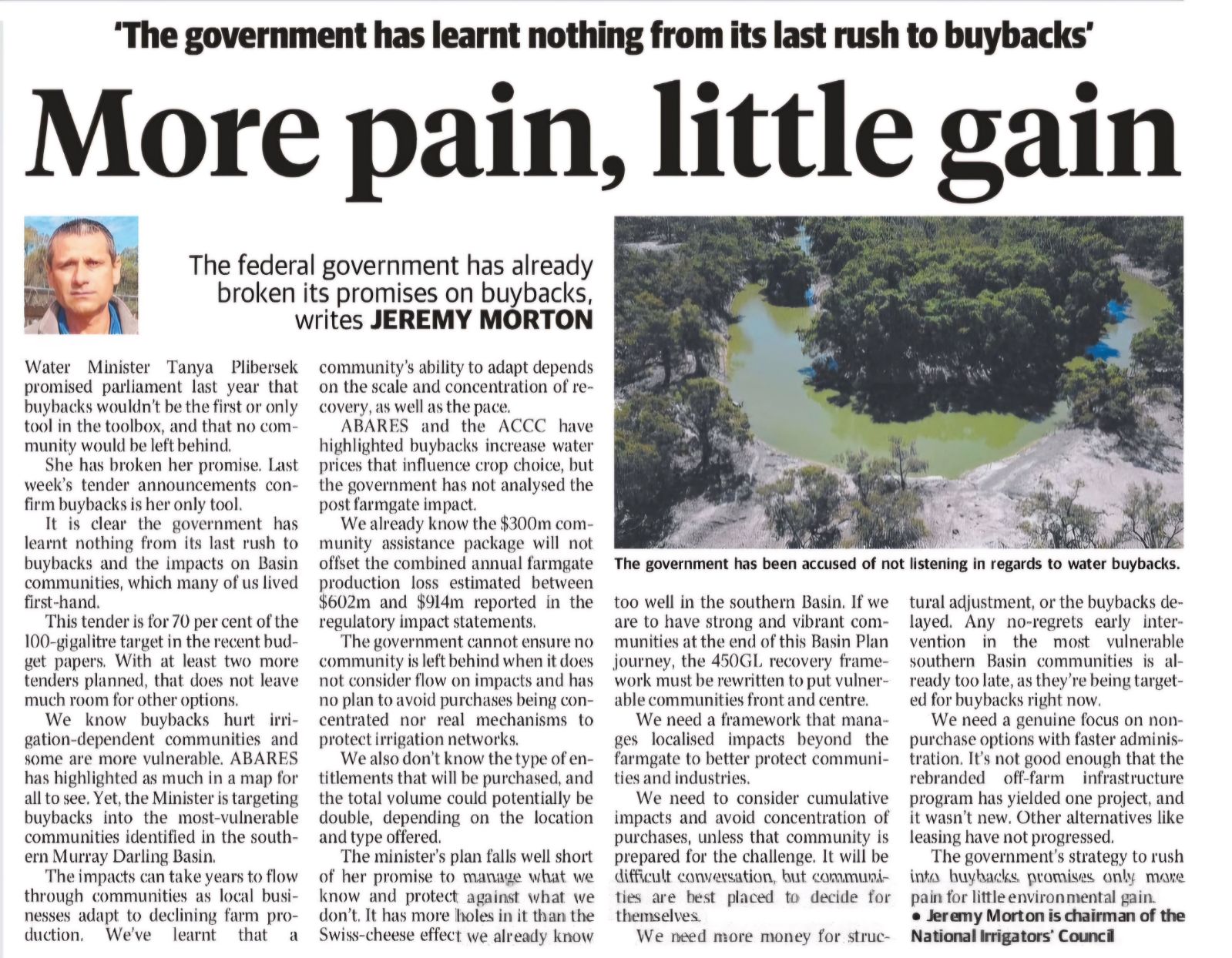
The federal government has already broekn its promises on buybacks writes National Irrigators' Council Chair, Jeremy Morton for the Weekly Times [...]
Six months since the Water Amendment (Restoring our Rivers) Bill ascended and despite assurances that all tools are in the toolbox, the Federal Water Minister, Tanya Plibersek is opting only for one, to fund buybacks1. The first communities in the firing line being the Southern Murray Darling Basin despite not knowing the likely impact.
Government’s amendment to Basin Plan impacts keeps communities in the dark 12 June 2024, Caberra, ACT: The Australian Government is attempting to use the $300 million Sustainable Communities Program to divert attention from their addendum to the Murray Darling Basin Plan regulatory impact assessment which lacks transparency on the true cost of the Basin Plan […]
VIC Basin deal must reignite old and new win-win projects for all states Canberra, ACT – The National Irrigators Council (NIC) is relieved that the stalemate between the Australian Government and Victoria appears broken with agreement to fund Victoria’s stalled Sustainable Diversion Limit Adjustment Mechanism (SDLAM) projects. This crucial step is a win-win for Victoria […]
ACT Basin Plan deal seeks to close the gap but triggers the need for more transparency Canberra, ACT – The National Irrigators Council (NIC) welcomes the recent announcement by the Federal Water Minister regarding the finalisation of bridging the gap in the Australian Capital Territory (ACT), signalling further progress towards Basin Plan implementation. The deal, […]
The Murray Darling Basin Plan has been a vital tool in balancing the needs of our communities, our environment and our productive sector. It hasn’t always got it right, but it has achieved a great deal since its inception. Ensuring balance is needed so we can keep our rivers and communities healthy and thriving, while feeding and clothing Australia and the world. Whilst we didn’t agree with all elements of the Restoring our Rivers bill such as the lifting of the cap on buybacks and the ability to use direct water purchases towards the 450 GL efficiency measure program. We remain committed to finalizing the Basin Plan and ensuring all the tools, not just buybacks, are utilized in its implementation to maintain and protect the prosperity of our regional communities and agricultural businesses. [...]
Productivity Commission warns Basin Governments – don’t waste time, do your job The Productivity Commission’s Final Report into the 5-year Implementation Review of the Murray Dalring Basin Plan has highlighted significant concerns about Basin Plan governance, saying governments must shape up or fail said Zara Lowien, CEO of National Irrigators Council. “The final report has […]
NSW Confirms Buyback not the Answer. The NSW Government release of their ‘Alternatives to Buybacks Plan’ as part of their commitment to implement the Murray Darling Basin Plan has been welcomed by National Irrigators Council CEO, Zara Lowien. “It was a show of cards by NSW to reinforce their commitment to avoid buybacks”. “The focus […]
The National Water Initiative (NWI) has played a crucial role in shaping the future of water management in Australia and supporting the growth of the irrigation industry. In doing so, it has also reshaped many regional communities and irrigation industries, particularly when considering the impacts experienced to achieve sustainable levels of take and establishing the water market. Nonetheless, it is imperative that any updates to the NWI uphold the fundamental principles that are now the backbone of the industry. We must also recognize that the objective to achieve environmentally sustainable level of take has been or is near completion, in all developed water sources and consideration how this objective applies for remaining regions should be a future focus. [...]
Find out more about our community, and join our mission advocating for the Australian irrigated
agriculture industry.