
Review of additional Held Environmental Water
There have been several concerns raised regarding the Federal Government’s decision to purchase additional water from farmers that go beyond the water recovery required to ‘bridge the gap’ to reduce water usage to Sustainable Diversion Limits (SDLs), in the Murray-Darling Basin Plan (herein, the Plan). This is known as pursuing the ‘additional Held Environmental Water’ (HEW), or what is more commonly referred to as “the 450 GL program”.
The concerns relate to:
- the effectiveness or need for additional water acquisition,
- questions on how the Government’s actions are contributing to policy outcomes
- value for taxpayers’ money
- the growing evidence that signals alternatives approach to ‘just adding water’ are needed to enhance environmental outcomes around the Basin
- socio-economic and market impacts of ongoing purchases.
The water purchased under “the 450 GL” program is additional to what is required to achieve the Basin
Plan SDLs.
Most of the water cannot be physically delivered through rivers to intended effect, has low
environmental utility, is not aligned with the MDBA’s current science on environmental priorities and does not represent value for money.
An Independent Review of program outcomes is needed to inform current and future investment decisions
to enhance environmental outcomes.
Greater environmental outcomes could be achieved if the program focus and funding was redirected to community-supported constraints management, and complementary measures.
Not needed
1 in 3 litres of water from irrigation has already been recovered for the environment.
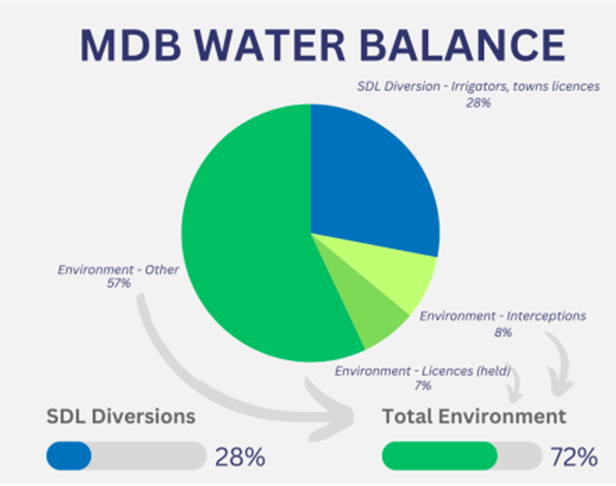
Total diversions for all users combined is now just 28% of inflows, well within global standards.
Not effective
It is also not cost-effective, with future implementation already $1 billion over budget.
Not the priority
Why this report?
There have been several reports on the implementation of the Basin Plan, and particularly on key programs. However, to date, the 450 GL purchasing program has not received this same scrutiny, despite being highly contested.
The reviews which have occurred have focused on outputs (i.e. the acquisition of water), rather than the actual outcomes that is intended to achieve, and the effectiveness of those purchases towards those outcomes.
What did we do?
This Report provides a preliminary assessment of the Federal Government purchases of additional water under “the 450 GL” program of the Plan.
Specifically, it looks at its alignment with:
- the Department of Climate Change, Energy, Environment and Water’s (DCCEEW) Framework to Deliver enhanced environmental outcomes in the Murray Darling Basin[1];
- the Commonwealth Procurement Rules[2];
- intended policy objectives as outlined within the Plan.
Key findings
This Report exposes flaws in not only the Government’s logic to prioritise more water purchases whilst SDLs are already in-force, without any long-term commitment to ensuring its utility, but also a failure to link outputs (volumes) with outcomes (environmental needs and benefits), even when considering value for money criteria. In addition, this report highlights ineffective measures to consider and minimise socio-economic impacts on communities from additional water purchases.
- The continued recovery of water beyond what is required for SDL compliance (i.e. additional HEW beyond 62 GL) is not commensurate with the scale and scope of Basin Plan implementation. The Federal Government has recovered more than double the minimum target and is now going beyond reasonable steps.
- 65% of entitlements purchased under the 450 GL program in the Southern Basin are subject to major delivery restrictions of some form, meaning they cannot be delivered through the river system as intended. For future purchases in EOI 1, 75% of what is on offer (and within market prices) is subject to delivery restrictions. This significantly reduces environmental effectiveness.
- Continuing to recover additional HEW, without constraints relaxed, is acquiring a public asset with no certain pathway to it being utilised to intended effect, anytime soon. Prioritisation must be for community-supported constraints measures, prior to additional water recovery.
- Spending under the 450 GL program does not reflect the Government’s own science on priorities for environmental investment in the Basin. The Government’s own environmental science finds flow-based indicators performing well but non-flow-based indicators scoring more poorly. This supports focus on complementary measures, as a higher priority than additional HEW.
- The Government will have to purchase the equivalent of more than 100% natural market annual turnover to achieve the 450 GL target.
- 100% of the 450 GL to date has been from water purchases in some form. There are no non-purchases options, all options by legislation must reduce the productive pool.
- Water recovery has not been steady nor staged, contrary to the Government’s purchasing framework.
- Poor socio-economic assessment, including data limitations and poor program implementation, means the Minister cannot meet legislative obligations to robustly consider socio-economic impacts.
- Almost all Framework principles and key measures to minimise the adverse socioeconomic impacts have not been implemented.
- The use of rules-changes that have reliability impacts as a water recovery tool risks substantial financial liability on Basin States, and major governance challenges, rendering the approach non-feasible.
- The continued recovery of additional HEW cannot be considered value for money, as per the Commonwealth Procurement Rules.
Ultimately, these findings unpack the Federal Government’s processes to demonstrate their legislative obligation to take “all reasonable steps” to acquire additional HEW up to 450 GL. It finds, in doing so, the Government’s actions do not align with their own principles and requirements, nor link to overall policy objectives, meaning acquisitions are unreasonable, as they are unlikely to be effective or deliver value for money.
This is because most of the water purchased cannot physically be delivered through rivers as intended, has low environmental utility, and doesn’t reflect the Government’s own environmental science on where investment must be targeted in the Basin.
Recommendations
This report highlights the need for independent review of the Federal Governments ongoing water purchases of additional HEW in the MDB, against the Commonwealth Procurement Rules, and policy objectives – an outcome review, rather than the current output focused reviews to-date.
In the interim, it is recommended that the Federal Government halts any further water recovery until such a review is undertaken, and the outcomes of the 2026 Basin Plan Review are known.
Further environmental investments in the Basin must reflect contemporary science on biggest priorities, which are signalling the need to move beyond just adding water, to invest in complementary measures instead, alongside community-supported constraints management. Such a shift would enable value for money requirements to be more clearly met, as well as optimising environmental utility from existing and future Commonwealth procurements.
If a shift in approach is not made now, then we risk achieving the intended environmental outcomes at significant expense to Australian taxpayers and regional economies.
Background
The Basin Plan
The Basin Plan commenced
 in
2012, to address ‘over-allocation’ by establishing Sustainable Diversion Limits (SDLs) and reducing water usage to comply with these new
limits.
in
2012, to address ‘over-allocation’ by establishing Sustainable Diversion Limits (SDLs) and reducing water usage to comply with these new
limits.
SDLs came into effect in 2019 and are now being fully complied with.
Following the Basin Plan, just 28% of the total water balance is diverted, with 72% for the environment.
.png) Full compliance with SDLs has been achieved. The diagram below shows actual water usage each year (blue columns) since SDLs came into effect
(red line). The striped area shows how much more water could still be taken and still achieve long-term compliance with the SDL. Water usage
is well below SDLs.
Full compliance with SDLs has been achieved. The diagram below shows actual water usage each year (blue columns) since SDLs came into effect
(red line). The striped area shows how much more water could still be taken and still achieve long-term compliance with the SDL. Water usage
is well below SDLs.
.png)
There has been a significant decline in water usage in the Basin. Diversions in the Basin have, at most times, halved from pre-Plan levels.
This has been the result of the following programs, which have ‘recovered’ water from users (mostly farmers) for the environment. Combined
with pre-Plan water recovery programs, there has been a transfer of nearly one-third of consumptive water entitlements to the environment.
SDL Adjustment Mechanism
The additional HEW, or “the 450 GL”, is part of the SDL Adjustment Mechanism (SDLAM).
- In 2017, surface water SDLs in the Southern Basin were adjusted on the basis that ‘SDLAM projects’ would come into operation, offsetting the need for greater reductions.
- The original timeframe for these projects to be operational was 30 June 2024, but this was extended to 31 December 2026 as part of the Restoring our Rivers Act.
- The package of measures increased the SDLs by 605 gigalitres per year (GL/year). This was based on outcomes from a package of 36 supply and constraints measures. Note: this is assessed as a total package, not individual projects.
- The Basin Plan limits the amount that SDLs can be adjusted, to up or down by 5%.
- At the time of the original determination, the Basin-wide SDL was 10,873 GL, so 5% of this is approximately 543 GL.
- Therefore, a minimum of 62 GL of additional water savings through efficiency measures or additional held environmental water is required to pass the 5% rule (i.e. from “the 450 GL”), and achieve the full effect of the 605 GL.
- SDLAM enables efficiency measures to be progressively developed until 2026, and additional held environmental water to be acquired until 2027.
There is confusion and contention on whether the full 450 GL is a mandatory component of delivering the Basin Plan “in full”. Politically,
the Federal Government has made this commitment. However, this is not what the Plan says, or how it was intended to operate. This is further
unpacked in the full report. In short, given the way SDLAM operates, only 62 GL of this program is required to facilitate the full offset of
605 GL (supply and constraints projects), any more is additional or optional extra, and any less would reduce the volume of the offset
available on the other side of the equation.
Progress so far
| Target |
Progress (as of 30 September 2025) |
Remaining |
% complete |
|
| Bridging the Gap |
2,075 GL |
2,062.2 GL |
15.7 GL |
99.4% |
|
SDLAM Supply & Constraints |
605 GL |
250 - 350 GL/y (estimate)* |
255 - 355 GL (estimate)* |
41% - 57% |
|
SDLAM Additional HEW (‘the 450’) |
Minimum: 62 GL* * Maximum: 450 GL |
145.6GL registered as of 30 September 2025 |
0 GL to minimum 280.2 GL to maximum |
100% of minimum 38% of maximum |
Note: Given the pace of the program, these figures are updated frequently. See DCCEEW website for regular updates.
Resources
Full Report
NIC Review of Federal Government purchases of additional Held Environmental Water (the “450 GL”) under the Murray-Darling Basin Plan

Basin Plan
NIC webpage on the Murray Darling Basin Plan

Moving Forwards
NIC Basin Plan Review
[1] DCCEEW Framework for delivering the 450GL
[2] Commonwealth Procurement Rules 2025