
Murray-Darling Basin Water Balance Report
Thirty years of reform in the Murray-Darling Basin (MDB) has focused on ‘rebalancing’ water use. This has been to strike a sustainable balance between water diverted (that is, water used for human consumption, such as town water supplies, agriculture, and other industries) as well as water not diverted that remains in river systems, ensuring environmental outcomes can also be achieved.
These reforms began in the 1990s, in response to concerns at the time of ‘over extraction’, and the need to tip the balance back towards
water remaining in rivers for the environment.
Therefore, a key piece of information to understand and review water management in the MDB is where that balance is now - between water
diverted for human uses, and water not-diverted to remain in rivers. This goes to the original purpose of the Basin Plan.
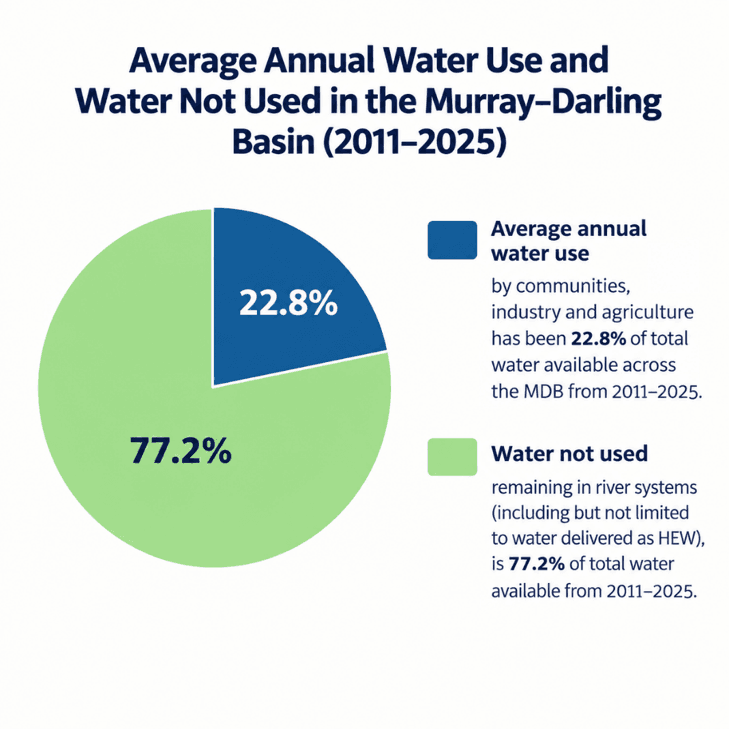
The Report’s key finding is clear: just 23% of available water is diverted for human uses, leaving 77% in rivers, wetlands, and floodplains to support the environment.
While this may sound like a simple categorisation, this Report has been developed in response to the complexity of reporting on environmental water in the MDB, which tends to occur in piecemeal components often with a focus on entitlements or water licences, not all forms of water. Without a clear understanding of how these different components interact, reporting them in isolation can create a misleading picture of the overall water balance, potentially understating the water supporting the environment and overstating the proportion used by agriculture.
Reporting on the quantities of entitlements purchased (or recovered) from the consumptive pool remains an important metric, as it demonstrates the degree of change which has occurred from major reform. However, a central gap, is clear reporting on the components of a full water balance. The full water balance includes looking at total water available such as inflows, rainfall and water in storages – and how it is then managed – including: water licensed to be used by communities, industry, and agriculture; water licences recovered for the environment; water that continues to flow through rivers without being extracted largely for environmental and ecosystem benefits; natural losses and more.
This Report therefore looks to actual data, from the from the National Water Accounts, provided by the Australian Government Bureau of Meteorology (BoM)[1] which provides a simple breakdown of water ‘take’ (i.e. diversions or use), and total water available.
Put simply, this Report seeks to answer what we observe to be the most asked question on the MDB: what is the percentage of water actually used in the MDB now, and how much remains in our rivers?
MDB Water Balance Report, October 2026
How much water is actually used in the Murray- Darling Basin?